Start With Your Credit Reports
Denied for a loan, or offered a rate that doesn't make sense? The answers are usually sitting in your credit reports. Start by seeing exactly what's there.
A denial or a rate that feels too high is often the first sign that something on your reports needs attention. You might find an account you've never seen, a balance that doesn't match your records, a late payment you know you made on time, or a collection entry you don't recognize. Until you understand the details, it's hard to know what deserves your attention.
Our credit report review service walks you through the information on your reports — account statuses, payment history, balances, inquiries, and the rest — in plain language. The focus is finding potential inaccuracies and helping you understand your options. It doesn't promise a particular score change or lending result, and we'd be wary of anyone who did.
In Austin, a review usually starts with something specific: a lease near the UT campus, a first home in Round Rock or Leander, a car loan for the I-35 commute, a better rate on a card you already carry. Whatever brings you here, we go through all three bureaus — Equifax, Experian, and TransUnion — line by line, so you see what lenders see before you apply.
These are actual results from past clients, previously shared on Instagram. Every credit file is different, so treat these as examples of what the process can look like, not as a promise of what yours will do.
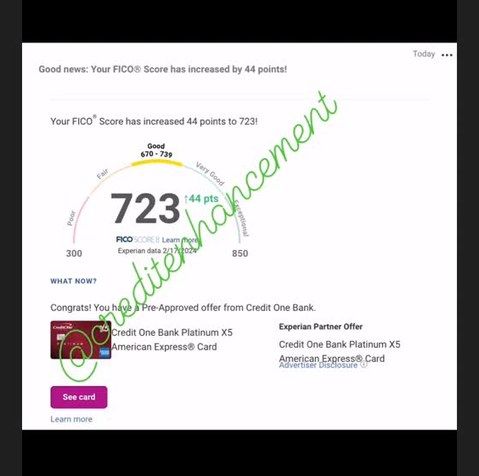
A client's Experian FICO score rose 44 points to 723 in February 2024.

Client approved for a USAA Rewards American Express card with a credit limit of 15,000 dollars, June 2019.
Results vary from person to person and depend on what is in each credit file. Nothing here promises a particular score increase or deletion.
Nobody should know your credit file better than you do. For a dollar, you can pull all three bureau reports yourself — Equifax, Experian, and TransUnion — and read every entry before you sit down with anyone.
Walk into your review already knowing what's on the page.
Your first week with MyScoreIQ is $1, then $34.99 a month. Cancel anytime.
One bad entry isn't the whole story. A useful review takes in the complete picture — these are the areas we go through, and why each one matters.
We go through reported account names, ownership details, opening dates, and statuses — the details that reveal accounts you don't recognize or that were reported incorrectly.
We explain how payment patterns, late payments, and account statuses show up on your reports, and what to look at when the details don't match your records.
We walk through reported balances and available revolving credit, and how utilization is commonly weighed by credit scoring models.
We look at what's shown for collection accounts and charged-off debts — the amounts, the dates, and the account status details.
We explain hard inquiries versus soft inquiries, and help you spot ones you don't recognize or that look wrong.
We explain what each entry means in everyday language, so your decisions rest on understanding rather than guesswork.
Our review is built to find information that may be inaccurate, incomplete, unfamiliar, or inconsistent.
We draw a clear line between information that may be inaccurate and negative reporting that is accurate.
Tell us what's on your mind — a car loan, a mortgage, a lease, a high rate, or something else entirely.
We talk through the reports and account details you have, focusing on what's relevant to your concerns.
We help you spot entries that may be worth investigating further or disputing on factual grounds.
We lay out possible next steps and talk about responsible habits that support your wider financial goals.
It helps. Equifax, Experian, and TransUnion don't always report the same information, so checking all three gives you the fullest picture. We recommend going through every report available to you.
A review can surface accounts or inquiries you don't recognize, which may point to identity theft. Suspected identity theft should also be reported through the proper identity theft and credit reporting channels.
Checking your own report is generally a soft inquiry and doesn't lower your score. That's different from certain lender applications, which involve hard inquiries.
Having them ready makes the conversation more productive, but you can reach out first — we can talk through how to get them.
Start with a closer look at your reports. Call (512) 254-7810 or request a consultation online.